Which Bible Translations are Copyrighted, Which Ones are Public Domain, and How to Check Before Using Scripture on Your Products
You’ve got the perfect Bible verse in mind for your product design. A mug, t-shirt, maybe a piece of art with scripture taking center stage. But what about copyright laws? Do they apply to Bible verses the same way they apply to other quotes and intellectual property?
Then the question hits: Am I actually allowed to sell this? Because “WWJD” is definitely not followed by “receive a copyright complaint.”
You’re among many Christian businesses if you’re wondering whether you can legally use Bible verses on your merchandise. The short answer is yes, for certain Bible translations, as long as you follow the copyright guidelines for your chosen Bible translation.
The key is knowing that not all Bible translations are public domain or free to use commercially on all products and merchandise. Many Bible translations are protected by copyright, and using them, if allowed, means following certain rules set by the copyright owner (like the publisher or Bible society).
We put together this quick guide to walk you through what’s allowed, what requires permission, how to get permission if you need it, and where to check before listing your products.
Why Following Bible Copyright Restrictions Matters
Ethics and Stewardship
We’re going to gloss over this one quickly. We’re speaking to Christian businesses here, so we know respecting usage guidelines and honoring the time and resources it takes to make the Bible accessible is something you’re already considering with integrity.
Legal Protection
If you use scripture quotations on a commercial product in a way that you don’t have permission for, you’ve infringed on copyright, even if you did so inadvertently. That could cause legal issues, such as being asked to take down your product or even being sued.
3 Concepts to Understand About Copyrighted Bible Translations
First, the disclaimer: We know copyright rules can feel confusing at first. Our goal with this guide is simply to help you navigate the process with more confidence and clarity. We aim to help you learn how to find and follow Bible copyrights — but that means you are still responsible for checking the copyright permissions for the version you want to use.
That may mean checking the public domain, a publisher’s website, or even consulting a copyright attorney. This isn’t legal advice, and Godly Goods™ isn’t responsible for errors or omissions. This article applies to copyright laws in the United States; other countries you sell your products in may have other restrictions. This info is current as of May 2026 and can change at any time, so make checking the copyright a habit.
And now that we’ve got that out of the way…
Second, you need to understand the specific copyright guidelines for each one of your products. Copyright holders make rules for each type of use case. The rules for legally using scripture often depend on how you’re using the scripture, how much of it you’re quoting, and what type of product you’re producing.
Third, the requirements for your products will generally fall into one of these four categories:
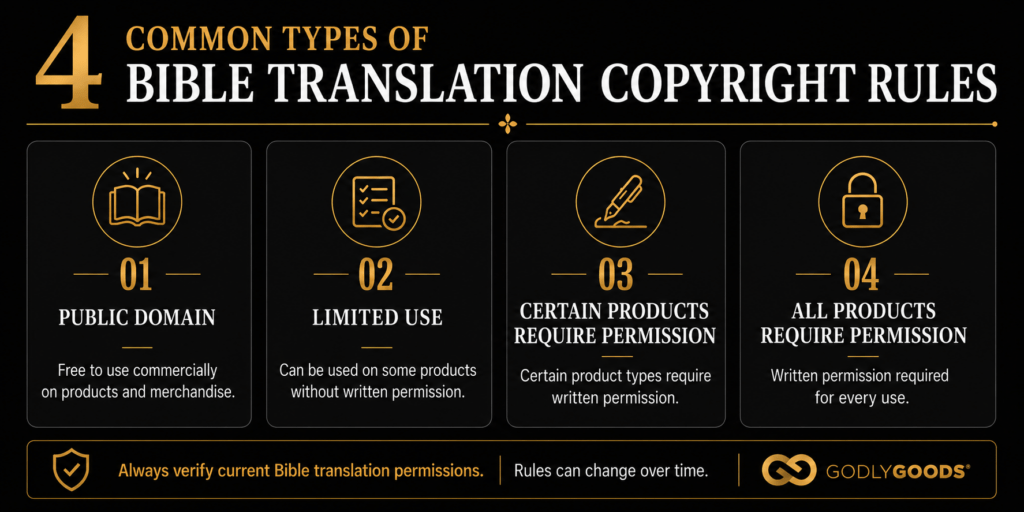
For instance, you may need written permission from a copyright holder to use a single verse on your t-shirt design, while another business owner may be able to sprinkle Bible verses from that same translation throughout their devotional with only an attribution on the copyright page of your book.
And another business owner may want to use a translation in a way that requires them paying royalties to the publisher.
In other words, use case matters, so check the copyright rules for each specific product.
Public Domain Bible Translations You Can Use Commercially
What does public domain mean? Essentially, they are works that belong to the public. It’s creative works, inventions, and information that are not protected by copyright, trademark, or patent. This includes older books and other creative works where the copyright has expired.
You can use Public Domain Bible verses for commercial use on any type of your work.
In the US, there are several Bible versions that are in the public domain:
- American Standard Version (ASV)
- Darby Translation (Darby)
- Douay-Rheims (DRA)
- King James Version (KJV)
- World English Bible (WEB)
- Young’s Literal Translation (YLT)
If you quote from a public domain Bible translation, you can freely use it for any commercial use. You aren’t required to specify which version you’re quoting from, but it’s considered best practice to do so when you can.
Limited Use – Bible Translations You May Be Able Use on Merchandise Without Written Permission
Many Bible translations can be commercially used for certain types of products and merchandise without having to get written permission from the copyright-holder, as long as you follow the use guidelines they provide.
Many of the versions in this category allow greater use for written and media content while still requiring written permission for use on artwork and products like shirts and mugs. However, there are a few that allow you to use their scripture on those types of products without having to obtain written permission.
Here’s a partial list broken down into two categories with links so you can verify the copyright permissions before producing your product:
Limited Use (Written Content and Media Likely Need No Written Permission, but Other Types of Products Require Permission)
- English Standard Version (ESV)
- Good News Translation (GNT)
- New Living Translation (NLT)
- The Message®
Expanded Limited Use for All Types of Products (Easy to Use for Digital and Physical Artwork, Planners, Apparel, Home Decor, etc.)
- Amplified® Bible (AMP)
- La Biblia de las Américas® (LBLA)
- New American Standard Bible® (NASB®)
- Nueva Biblia de las Américas (NBLA)
Bible Translations Where Permission is Required for ALL Commercial Use
With these Bible translations, you must contact the copyright holder for permission to quote scripture on your commercial products and projects in every case:
- Christian Standard Bible® (CSB®)
- New International Reader’s Version® (NIrV®)
- New International Version® (NIV®)
How to Check Whether Other Bible Translations Can Be Used Commercially

If you want to quote scripture from another Bible version on your product, you’ll need to find the copyright holder and check the permissions.
Biblegateway.com is an easy place to start. They list all the Bible versions available on their website, and when you click on one, you’ll see the publisher. The publisher’s website usually has a “permissions” page (check the footer).
A good old Google search is another easy option. Try a search query like, “How to get permission to use NKJV scripture commercially,” and it’s likely one of the first search results will help you find who owns the copyright and what the permissions are.
The Recap
So, can you use Bible verses on merchandise? Yes, but it depends on the Bible translation, your product type, and the publisher’s copyright rules.
Just follow a few simple guidelines before using Bible verses on your commercial products:
- Use public domain Bible translations freely for any of your merchandise.
- Research other Bible translations’ copyright before use by visiting the publisher’s permissions page.
- Check the copyright for each and every product because the rules vary by use.
And remember this is free, friendly advice and not legal advice. Check with the publisher or a copyright attorney if you have doubts or questions about using a specific Bible translation on your products.
We hope this Bible Copyright Guide has been helpful! For more tips and encouragement for Christian businesses, sign up for our newsletter.
And if you’re growing a Christ-centered business and looking for a marketplace designed to connect businesses like yours with Christian shoppers, we’d love to invite you to apply to become a Godly Goods™ Seller!
We believe honoring God in business includes not only what we create and sell, but also how we create it. Since you’re here learning how to do the same thing, it sounds like our values align.